A Collective Effort Driving Real Progress
The team at Strategy Engineering Research Group would like to thank the speakers and participants who came together to make Water CX Customer Transformation 2025 a genuinely valuable benchmark for the sector. This was a concentrated exchange of evidence, experience, and practical insight at a moment when customer strategy, regulatory pressure, and public scrutiny are converging in new ways.
From the Watercare New Zealand breakfast briefing at 8:45am through to the closing session at 5pm, the day moved from international cases to UK operational realities, connecting smart metering, leakage, trust, capital delivery, and affordability into one coherent conversation about what is genuinely holding the sector back—and what can now be done differently.
We heard from:
Mumin Islam, Head of Innovation, South Staffs & Cambridge Water: A Case Study on Inclusive and Personalised Community Engagement & How This Has Helped Build Trust
Dr Armenak Antinyan, Head of Behavioural Economics, Thames Water: The Behavioural Lens: Using Behavioural Science to Solve Customer Challenges in the Water Sector
Sarah Castelvecchi, Consumption and Behaviour Change Lead, Anglian Water: Removing Barriers' within Customer Side Leakage Journey and Enhancing the Communications.
Natasha Tuke, Head of Customer and External Communications, Anglian Water @one Alliance Customer Team - Designing a Customer-First Operating Model: Embedding Experience at the Heart of Capital Delivery
Gary Adams, Head of Metering Operations, Northumbrian Water: Designing a Customer-First Operating Model: Embedding Experience at the Heart of Capital Delivery
James Walker, Director, Dispute Resolution Ombudsman: Key Learnings From Outside Sectors on Effectively Resolving Customer Issues & Disputes
Theresa Malloy, Customer Insight Specialist, Watercare Services, Auckland, New Zealand: Understanding Customer Attitudes to Smart Metering in Auckland, New Zealand
Benjamin Gardner, Professor of Psychology, University of Surrey - Understanding Human Habits and How Customers Make Water Use Decisions
Matt Dickens, Sustainability Manager, Santa Clara Valley Water Authority, California - Experiences With Water Conservation
Krishane Patel, Financial Services Behavioural Science Expert - Prioritizing the Customer Journey - Lessons Learned from the Financial Services Industry And Application to the Water Industry
Where Customer Programmes Fail—and What Is Working?
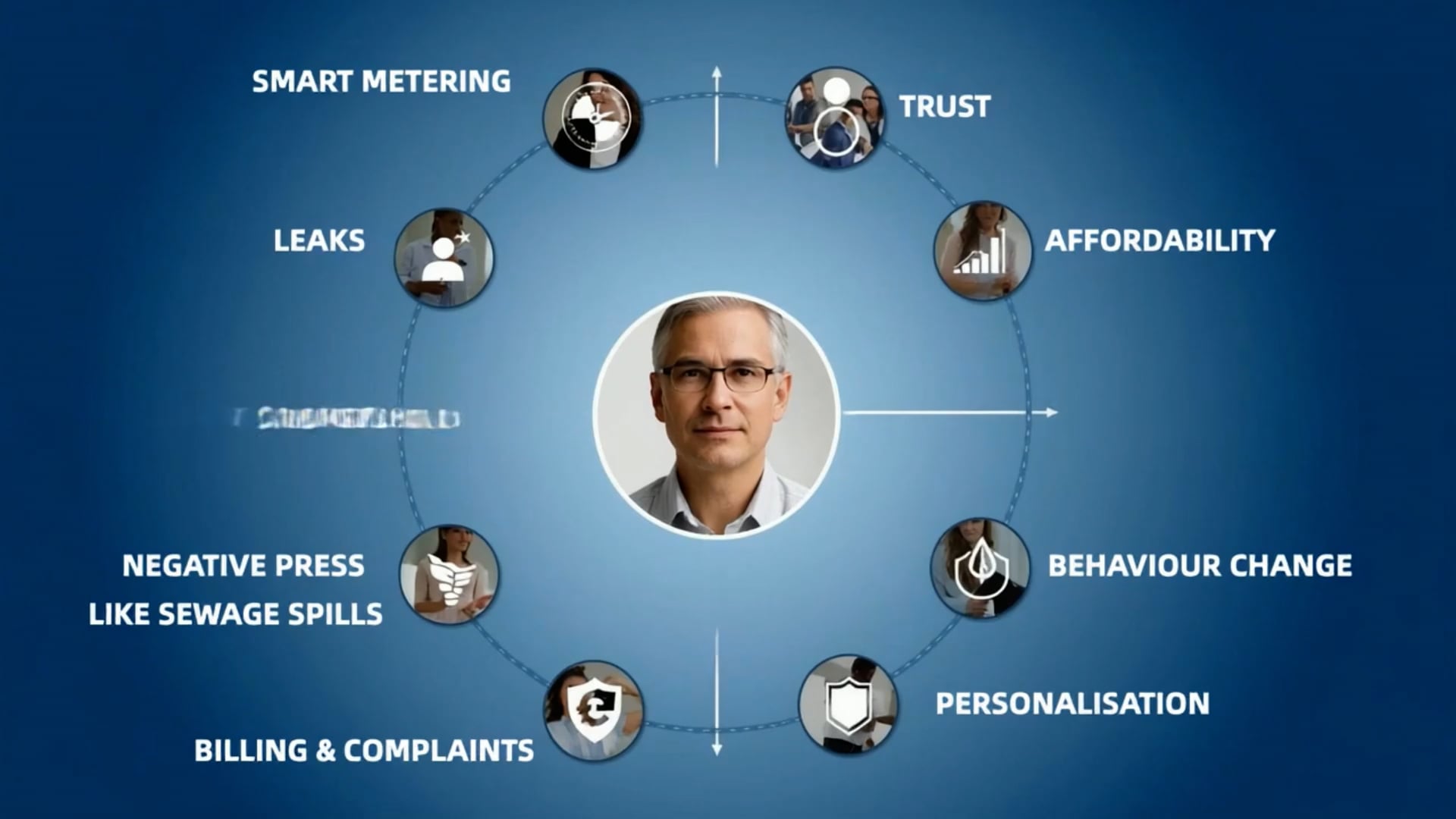
A central focus of the day was understanding why traditional customer programmes often fall short and what a more effective, behaviour-smart approach now looks like. Trust remained the defining theme, but what made the discussion powerful was the framing: trust as something shaped by behavioural science, vulnerability, affordability, communication design, installation experiences, billing friction, capital delivery disruption, and even reputational shocks such as sewage-spill narratives—regardless of whether a given utility was responsible. The failure points were examined honestly, and so were the solutions.
Evidence came from California, New Zealand, Anglian Water, Thames Water, and Northumbrian, each offering practical progress on how redesigned onboarding journeys improve smart-meter acceptance, how behavioural nudges strengthen digital communications, and how empathy and EQ are most effective when paired with clarity, consequence and realistic expectations—not with endless reassurance or “the customer is always right” thinking.
Trust and behavioural science were not discussed in isolation; they were explored through the lens of diversity, inclusivity and lived experience. Speakers demonstrated how structured community mapping and formal partnerships with mosques, churches, and community centres create more meaningful engagement—particularly with ethnic minorities, vulnerable groups and communities historically under-represented in water-sector conversations. The message was clear: customer engagement does not begin or end at the contact centre. It is built in neighbourhoods, homes, and community institutions by meeting people where they already are.
Designing Billing and Alerts With Behaviour in Mind
There was significant focus on reducing billing complaints by redesigning layouts and communication formats so they lower cognitive load and improve clarity. On customer leakage, we explored why many households ignore notifications even when alerted—often due to message framing, competing priorities, or the perception that leakage is a “utility issue” until proven otherwise. Behavioural insights and practical examples offered clear, tested alternatives that drive higher response rates and more constructive conversations.
Benchmarking ‘Good’ by Looking Outside the Sector
Cross-sector insights, particularly from financial services, showed how faster feedback loops and proactive dispute resolution can materially reduce complaints and regulatory risk. The Dispute Resolution Ombudsman provided a benchmark for what “good” looks like in sectors with high emotional stakes, helping water utilities understand how to close the loop earlier, intervene before escalation, and treat complaints as risk signals rather than operational noise.
While the regulatory challenges facing water utilities through AMP8 are significant, the conference made clear that real progress is underway. There is a more honest recognition of human behaviour in service design, stronger affordability and vulnerability strategies, and tangible improvements in complaints handling and customer engagement. Yet the panel discussions were equally clear: substantial work remains if trust is to be rebuilt consistently across all regions and communities. The shift regulators are now signalling—from compliance to credibility—means customer trust is no longer a reputational question; it is operational, structural, and measurable.
For deeper reflections on these themes, you can explore the Chair’s Remarks available on this site.
To access the full picture—including all session videos, Day 2 seminar recordings, and our 300-page integrated report combining transcripts, slides and editorial analysis—you can download the complete post-conference package.
Dates for The Diary - Where Smart Water Metering Meets Customer Transformation—and Europe Sets Its New Standard – June 23 & 24 2026, Brussels
Smart water metering and customer-experience transformation are converging at speed across Europe. Emerging EU requirements for digital water, real-time consumption visibility, leakage reduction and data transparency are pushing every member state into active deployment. There is also a growing recognition that the UK’s journey offers valuable lessons—both on what works and where the pitfalls lie.
Across our early conversations with water utilities, one theme is consistent: technical upgrades fail without customer buy-in. Metering programmes stall when onboarding is weak. Leakage alerts go unanswered without behavioural insights. Billing reform is impossible without accurate metering data. These are now shared challenges with shared consequences.
So next year, we are bringing both agendas together—two high-intensity one-day conferences, linked by a shared strategic vision and a shared exhibition floor.
Day 1 will focus on Smart Water Metering, with plenary sessions and specialist streams featuring deployments from drought- and scarcity-affected regions—Southern Europe, Spain, Portugal, Italy, Greece—as well as Northern Europe, France, Belgium and Germany, where metering projects are now accelerating with real urgency.
Day 2 will focus on Customer Transformation and Customer Experience in the water sector. It will run from early morning to late afternoon, with hard-hitting plenary content and multiple deep-dive streams that reflect the full breadth of CX leadership roles across utilities.
Across both days, we will host hands-on workshops on how utilities deploying new smart metering technologies can ensure that customers come on the journey—practically, culturally and behaviourally.
As one water utility put put it: “Smart metering delivers the data; customer transformation delivers the outcomes. Together, they deliver the regulatory, financial and trust gains the European sector now requires.”That statement captures the rationale for this platform. This will be the definitive annual forum on demand management, digital customer engagement and leakage reduction—anchored in the customer perspective and built for operational reality.